
The setup
Before I ever touched it, the Yeeps Plush already had proof of demand: a single batch of 10,000 units that sold out in 5 minutes. Yeeps is Trass Games’ free-to-play social VR game — people describe it as “the Minecraft of VR” — with 360K+ monthly active users on Meta Quest. That first plush drop proved people wanted their in-game character as a physical thing. Nobody had built the operation to make that repeatable.
I met Jayshay, who’d led that first plush effort, at a Maker Faire booth where I was showing Angl. They needed someone to turn a one-off spike into an actual line and business. I’d been indie-hacking Angl solo and wanted to build inside a team again — good timing on both sides. They brought me on as Product Manager, Plush & Merch, from March to November 2025.
What I owned
I ran the physical merch line end to end:
- Design — the Yeeps Plush Pets line (dog, cat, chicken, dragon): a collaborative process with the art team and with my boss Jayshay on creative direction — concept, packaging, and multi-colorway schemes down to stitch-level specs. I owned turning that into the actual documentation and tech packs sent to the factory, and ran the manufacturer calls.
- Manufacturing — held a $34.99 price point through the whole run, resolving hard factory constraints (magnet rotation, 3D vs. embroidered detail, felt spines) directly with overseas manufacturers instead of watering down the design to hit cost. I also built the production and shipping timelines themselves — timing manufacturing and freight months in advance so inventory landed in the US, UK, Canada, and Australia in time for the holiday season. This was the furthest out I’d ever had to plan, and it was genuinely hard — every detail had to be right that far ahead, with no room to course-correct late.
- Sourcing & ops — sized and ran 60,000+ units across purchase order batches of roughly 20,000–30,000 units at a time, spanning the US, UK, Canada, and Australia, based on conversion and player-base data — coordinating international warehousing, ShipBob fulfillment, and QIMA quality inspections.
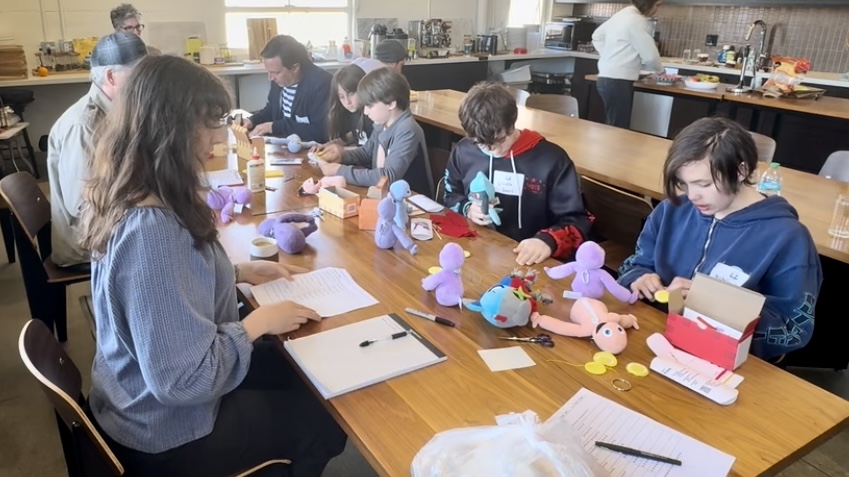
- Validation — Jayshay owned the Maker Kit beta program (500–1,000 units) that de-risked new SKU ideas before full production; I played the support role — building the Google Forms, coordinating with parents by email, scheduling sessions, and arranging building access for testers.
- Support & quality — standardized how we handled a recurring shipping issue (stuffing shifting position during international transit) with a care video, after almost losing a customer to social pressure in Discord over what wasn’t actually a defect.
Decisions that mattered
- Backpack-ready design call — I pushed for a loop and removable carabiner sewn into the back of each plush, so kids could clip it onto a backpack or keychain. Competitors like Squishmallows only had a loop too small for even a keyring — this made the product something kids could take with them, not just display.
- Tariff hit → pricing restructure — Instead of just absorbing the tariff spike as a one-off crisis, I used it to fix a pricing model problem: separating shipping from the plush price ($34.99 bundled → $29.99 + itemized shipping). That made buying multiple plushies for friends meaningfully cheaper and set up a more transparent, scalable structure as we expanded internationally.
- Pushed for “Dragon Fest,” an in-game event — Rather than let redeeming a plush’s promo code be a solo, one-off action, I pushed to build a synchronous in-game event where everyone who bought a plush could hatch their dragon egg together on the same day — turning an individual purchase into a community moment that extended engagement well past the unboxing.
Outcome
- $1.5M+ net revenue at 100% sell-through in the 2025 holiday season.
- 60k+ units sold through on the Plush Pets line I designed, plus tens of thousands more sold on the original Yeeps Plush product line — which I managed and grew, though I didn’t start it from zero.
- Held the $34.99 price point through a tariff shock without permanently passing the cost to customers.
What it taught me
This is the clearest example I have of a different pattern than Angl or Promaia: those are zero-to-one, building something out of nothing. Trass was one-to-n — the demand already existed before I ever touched it (10k units gone in 5 minutes), but only MVP infrastructure sat behind it. My job wasn’t to invent demand; it was to build the pipeline sturdy enough to catch it at scale without breaking what made people want it in the first place.
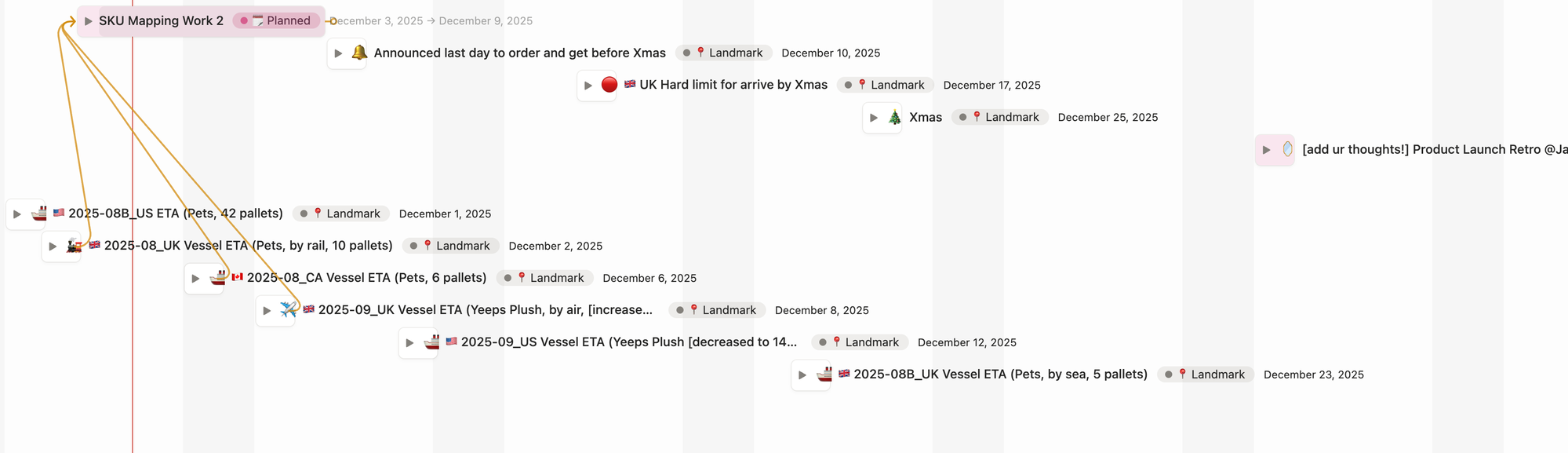
But the lesson that actually changed how I work day to day wasn’t that framing — it was learning to stop stopping at the first wall. On the UK track specifically, I underestimated the regulatory timeline early on and it cost us a real month, not a hypothetical one. That loss rewired how I worked: instead of hitting a blocker and immediately going to fix that blocker, I started asking what’s actually on the other side of it — another wall, a hard delay, something else entirely — before committing to a plan. By the end of the UK track I was sending far more “what comes after this, and after that” emails, mapping the full dependency chain in Notion instead of solving one step at a time. It’s basic project management, but I’m self-taught, and this is where I actually earned it instead of reading about it.
What made it stick wasn’t the process — it was realizing what was actually on the other end of my mistakes: tens of thousands of kids for whom this plush was their whole world, and I was the one holding that. That’s what pushed the habit past “good practice” into something I held myself to. That weight is also why the US/Canada/UK launch going out with no errors, tied to the in-game dragon-hatching event I designed, mattered to me personally and not just operationally.
It changed how I communicate, too. I got much more careful about not giving false positives — telling someone a timeline’s fine when I’m not sure, or that something’s handled when it isn’t. I used to think experienced operators who came across cold or blunt were just cold. Now I get it: directness, even when it’s awkward, is what you owe people depending on you.
Knowing which pattern I’m in — zero-to-one or one-to-n — still matters. But mapping the wall and killing false positives are what actually followed me past Trass, into Angl and Promaia.